
Hormone therapy — also referred to as hormone replacement therapy (HRT) — plays a central role in modern menopause care and offers a range of effective treatment options. For many women, it can significantly reduce symptoms like hot flashes, night sweats, sleep disruption, vaginal dryness, and bone loss — and improve overall quality of life.(1)
However, not all hormone therapies are the same. Many women encounter confusing and sometimes conflicting information about “bioidentical” versus “synthetic” hormones. Some are told that bioidentical hormones are safer, while others are warned that they’re unregulated. Others believe synthetic hormones are the only scientifically supported option.
This article is to help clarify the science, define the terms accurately, and explain what the evidence shows. It also outlines how leading medical organizations — including the FDA and The Menopause Society — and findings from the Women’s Health Initiative (WHI) study inform today’s clinical approach to hormone therapy.
Defining the Terms: What are bioidentical and synthetic hormones?
All hormones used in menopause treatment must be manufactured in laboratories. None are taken directly from the human body. The key difference between bioidentical and synthetic lies in molecular structure — not whether a hormone is “natural.”(2)(3)
What are bioidentical hormones?
Bioidentical hormones are hormones that are chemically identical to the ones naturally produced by the body. This means their molecular structure matches human estrogen or progesterone precisely.(2)(3)
Common examples include the following:
Estradiol: This is the primary form of estrogen made by the ovaries before menopause. (Estrogen alone is typically prescribed only after hysterectomy.)
Micronized Progesterone: This progesterone is structurally identical to the body’s natural progesterone. (Progesterone is required when the uterus is present to protect the endometrium.)
Bioidentical hormones can be FDA approved or compounded:(3)
FDA-Approved: This refers to bioidentical hormones available in standardized doses in the form of pills, capsules, patches, gels, or creams.
Compounded: This refers to bioidentical hormones custom-mixed by compounding pharmacies in personalized doses.
It’s important to distinguish between these two. The terms “compounded hormones” and “bioidentical hormones” are often used interchangeably but have very distinct meanings:
Bioidentical Hormones: These are chemically identical to the hormones produced by the body. They can be either compounded or commercially manufactured.
Compounded Hormones: These refer specifically to customized formulations prepared by a specialized compounding pharmacy.
Winona uses FDA-approved bioidentical hormones in all treatments. FDA-approved bioidentical hormones meet strict standards for safety, quality, purity, and effectiveness.(3)
When compounding is used, the hormones themselves are FDA approved, but the custom-mixed formulations are not regulated by the FDA because they cannot individually evaluate each prescription. However, Winona’s pharmacies are 503A pharmacies and follow United States Pharmacopeial Convention (USP) compounding standards, which govern quality, purity, and safety.
What are synthetic (non-bioidentical) hormones?
Synthetic hormones — more accurately called non-bioidentical hormones — are designed to mimic the effects of natural hormones but have a different molecular structure.(1)
Two key examples include the following:(2)(4)(5)
Conjugated Equine Estrogens (CEE): These are derived from horse urine and composed of multiple estrogen molecules not found in the human body.
Medroxyprogesterone Acetate (MPA): This is a synthetic progestin that’s not structurally identical to progesterone.
These hormones were widely used in earlier forms of HRT and were the primary therapies studied in the Women’s Health Initiative (WHI) trial.(3)(6)
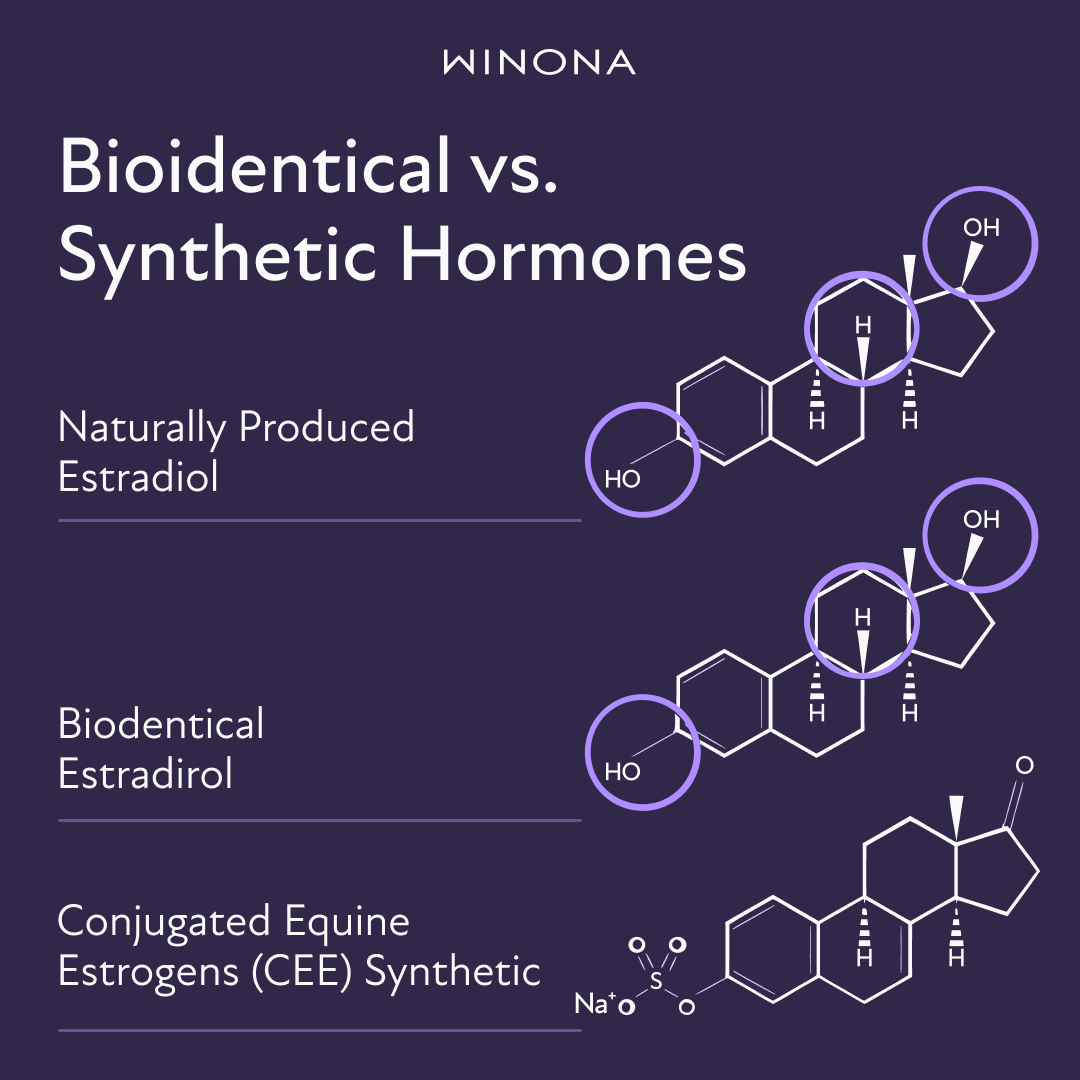
A Side-by-Side Comparison: Bioidentical vs. Synthetic HT
Feature | Bioidentical Hormones | Synthetic (Non-Bioidentical) Hormones |
Molecular Structure | Identical to human hormones | Different from human hormones |
Source | Typically plant-derived and chemically converted | Animal-derived (e.g., CEE) or fully synthetic |
FDA Approval Status | Available as FDA-approved and compounded forms | FDA-approved |
Dosing Flexibility | Standardized FDA doses; compounded options allow customization | Standardized doses only |
Key Clinical Studies | Studied thoroughly in modern menopause care; newer outcome data | Major data from the Women’s Health Initiative (WHI) |
What the Evidence Says About Safety and Efficacy
The Women’s Health Initiative (WHI)
The Women’s Health Initiative (WHI), launched in the 1990s, was a landmark study evaluating the long-term effects of hormone therapy in postmenopausal women. The trial primarily studied the following:(3)(6)
Conjugated equine estrogens (CEE)
Medroxyprogesterone acetate (MPA)
The results showed increased risks of breast cancer, blood clots, stroke, and cardiovascular disease — along with other potential side effects — in certain populations, especially older women and those who were many years past menopause when they started therapy.(1)(3)(6)
These findings led to widespread fear and a dramatic decline in hormone therapy use — even among women who might have benefited.(3)(6)
How Modern Understanding Has Evolved
Subsequent analyses and newer research clarified the following:(1)
Age and timing matter. Women who start HT closer to menopause generally have a different risk profile than those who start later.
The type of hormone matters. The WHI studied non-bioidentical hormones, not the bioidentical estradiol and micronized progesterone widely used today.
The route of delivery matters. Transdermal estrogen (patches, gels, and sprays) may carry lower risks of blood clots than oral estrogen.
Bioidentical Hormones and Safety
Growing evidence suggests that FDA-approved bioidentical hormones — particularly estradiol and micronized progesterone — have the following:(3)(4)(5)
A favorable cardiovascular profile
A lower impact on blood clot risk when delivered transdermally
A potentially lower breast cancer risk compared to certain synthetic progestins
These differences are thought to stem from molecular structure. Bioidentical hormones more closely match the body’s natural hormones, which allows them to interact more predictably with hormone receptors. Structure also influences how hormones are metabolized and how they act in different tissues.
The FDA’s Official Position
The FDA’s official stance on bioidentical hormones emphasizes the following:(7)(8)
Some bioidentical hormones are FDA approved and supported by clinical evidence.
FDA-approved bioidentical hormone products meet the same safety, quality, and efficacy standards as any other prescription medication.
Compounded bioidentical hormones offer personalized dosing for individual needs; however, unlike standardized medications, they cannot undergo the formal FDA approval process for purity and large-scale data.
FDA-approved bioidentical hormones remain the clinical benchmark standard for dosing and purity.
The FDA supports the use of hormone therapy when clinically appropriate and prescribed by a qualified healthcare professional.(7)
Guidance from The Menopause Society
The Menopause Society recognizes hormone therapy as the most effective treatment for vasomotor symptoms (hot flashes and night sweats) and genitourinary syndrome of menopause (GSM). The organization emphasizes the following:(9)
Individualized risk assessment
Use of the lowest effective dose
Preference for FDA-approved bioidentical products
Ongoing follow-up and reassessment

The Role of Personalized Care and Informed Decisions
No two menopause experiences are identical. Genetics, lifestyle, medical history, symptom burden, and personal preferences all influence treatment decisions. Choosing between bioidentical and synthetic hormones is not simply a matter of preference; it’s a critical medical decision.
Effective hormone therapy requires the following:
A thorough medical evaluation
Ongoing self and medical monitoring
Willingness to adjust therapy as the body changes
This is why clinical guidance — not internet advice or anecdotal claims — is essential when considering hormone therapy. Understanding the treatment allows women to participate meaningfully in their care — asking questions, becoming informed, and making decisions grounded in evidence.
The Evolution of Hormone Therapy in Women's Health
The conversation around hormone therapy has evolved significantly since the early 2000s. Today’s approach is more precise, more personalized, and more evidence-based.
The key takeaway is this: Molecular structure and individualized dosing matter. FDA-approved bioidentical hormones offer a scientifically grounded option to balance hormone levels that aligns closely with the body’s natural physiology.
Choosing the right hormone therapy is an important step toward long-term health and well-being — one that deserves expert guidance, thoughtful discussion, and ongoing support. A personalized medical consultation can help determine the safest and most effective option.